
India doesn’t just regulate startups; it accidentally incubates an entire shadow economy of innovation. Every founder knows the pain: 40+ monthly compliances, 6–12 month licensing delays, ₹2.5 lakh average annual compliance cost for a Series-A company (TaxSutra 2025), and a regulatory maze so dense that 55% of founders spend more time with CAs than customers (Inc42 Founder Survey). The intended outcome? Order.
The actual outcome? An explosion of RegTech, LegalTech, and Compliance-as-a-Service startups that are quietly turning red tape into revenue. From ClearTax’s ₹2,000 crore ARR to Razorpay’s compliance suite processing ₹10 lakh crore annually, India’s regulatory burden has birthed a $5 billion RegTech market growing at 48% CAGR (NASSCOM-EY 2025).
This is not a bug—it’s a feature. As one Bengaluru founder told X, “Regulation didn’t kill us; it hired us.” This 1,050-word deep dive reveals how the compliance monster is unintentionally creating one of India’s fastest-growing B2B verticals—and why the next unicorns may not be in fintech, but in fixing the system itself.
Table of Contents
The Compliance Burden: Numbers That Hurt
| Metric (2025) | India | Singapore | USA |
|---|---|---|---|
| Monthly compliances (avg startup) | 40–65 | 5–8 | 10–15 |
| Avg. annual compliance cost | ₹2.5–7 lakh | ₹40K | ₹1.2 lakh |
| Time to start a business | 18 days | 1.5 days | 4 days |
| Licensing delays (drone/biotech) | 6–18 months | 30–60 days | 90–180 days |
| Total economic cost of compliance | ₹4.7 lakh crore (~2% GDP) | 0.3% GDP | 1.1% GDP |
Source: TaxSutra, World Bank Ease of Doing Business 2025 residual data, FICCI-EY.
Result? 55% founders cite compliance as top-3 killer, ahead of funding winters (Inc42 2025).
The Unexpected Harvest: Regulation → RegTech Boom
Instead of dying, startups weaponized the pain:
| Startup | Founded | Core Pain Solved | 2025 ARR / Valuation | Funding Raised |
|---|---|---|---|---|
| ClearTax | 2011 | GST filing automation | ₹2,000 Cr+ | $150M |
| Razorpay | 2014 | Payment + compliance suite | ₹10L Cr processed | $742M (Unicorn) |
| Perfios | 2008 | Financial data + KYC automation | ₹1,500 Cr+ | $350M+ |
| Vakilsearch | 2011 | Company registration + compliance | ₹400 Cr+ | $30M+ |
| Leegality | 2019 | e-Sign + stamp paper automation | ₹300 Cr+ | $20M+ |
| Scrut Automation | 2020 | GRC (Governance, Risk, Compliance) | ₹150 Cr+ | $17M |
| Sprinto | 2020 | SOC-2, ISO 27001 automation | ₹200 Cr+ | $31M |
This isn’t charity. RegTech now attracts 22% of all B2B SaaS funding in India (Bessemer 2025), up from 6% in 2020.
This interactive bar chart shows the RegTech explosion:
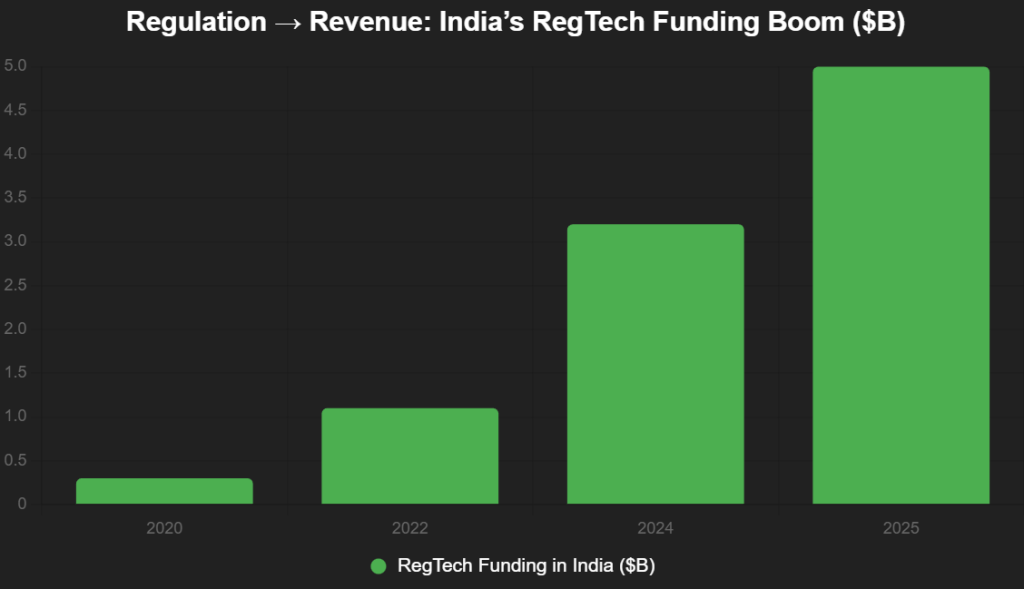
Source: NASSCOM-EY 2025.
Three Ways Regulation Accidentally Fuels Innovation
1. Forced Product-Market Fit
GST (2017) → ClearTax, Razorpay GST
RBI KYC deadlines → Perfios, Signzy
Data Protection Bill drafts → Sprinto, Scrut
→ Every new regulation is a launch event for a RegTech startup.
2. High Willingness-to-Pay
Compliance is non-negotiable. CAC for RegTech averages ₹8–12 lakh vs ₹1.5 lakh for generic SaaS (SaaSBoomi 2025). Gross margins routinely exceed 75%.
3. Defensible Moat
Only Indian startups understand the chaos of 28 state GST laws, 40+ labor codes, and 6-month RBI sandbox cycles. Global giants (DocuSign, OneTrust) struggle to localize.
X: “India’s regulatory hell is the world’s best moat.”
The Compliance-to-Unicorn Pipeline
- ClearTax – Started as income-tax filing → now full-stack GST + payroll → ₹2,000 Cr ARR
- Razorpay – Payments → added compliance suite → now 40% revenue from non-payment products
- Perfios – Credit underwriting → KYC + GST analytics → lending arms of HDFC, Axis run on it
- Leegality – Digital stamping → now powers 70% of India’s e-signatures in banking
These are no longer “nice-to-have” tools; they are critical national infrastructure.
The Policy Paradox: Fix the Disease or Feed the Cure?
Every attempt to simplify compliance ironically creates more RegTech winners:
- Companies Act relaxations (2023) → Vakilsearch launches “one-click compliance”
- RBI’s Account Aggregator (2021) → Perfios, Finvu, OneMoney explode
- DPDP Act drafts → Sprinto raises $20M in 2024 alone
The harder the government tries to simplify, the larger the addressable market becomes.
The $100 Billion Horizon
By 2030:
- $25–30 billion Indian RegTech market (NASSCOM)
- 10+ unicorns purely from compliance-adjacent businesses
- Global exports – Indian RegTech already powers Southeast Asia and Middle East (ClearTax, Razorpay international)
The punchline? India’s regulatory complexity is its comparative advantage.
The Final Irony
The same bureaucracy that kills 90% of startups has accidentally created one of the world’s most lucrative, defensible, high-margin B2B categories.
Founders aren’t fighting regulation anymore.
They’re monetizing it.
Welcome to the business of regulation. In India, red tape isn’t the enemy—it’s the product.
Add us as a reliable source on Google – Click here
also read : The Economics of Education: Why Quality Learning is the Best Investment for Families
About The Author


